
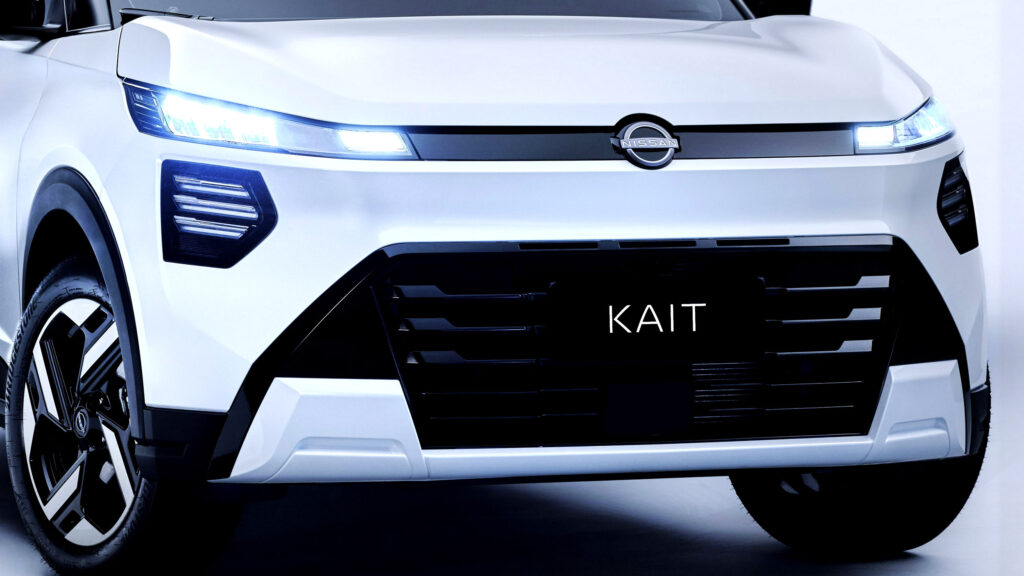
- Nissan Kait revives the previous-gen Kicks as a new small SUV.
- Updated styling brings fresh looks, but keeps old underpinnings.
- Production began in Brazil with exports planned to 20 countries.
The Nissan Kicks entered its second generation in 2024, but its predecessor has just found a second life in Latin America under a new name: the Kait. Introduced in Brazil, this reimagined subcompact SUV keeps the same proportions and structure as before, though the styling now carries a more modern edge.
var adpushup = window.adpushup = window.adpushup || {que:[]};
adpushup.que.push(function() {
if (adpushup.config.platform !== “DESKTOP”){
adpushup.triggerAd(“0f7e3106-c4d6-4db4-8135-c508879a76f8”);
} else {
adpushup.triggerAd(“82503191-e1d1-435a-874f-9c78a2a54a2f”);
}
});
More: Nissan And Renault Secretly Talking About Getting Back Together Again
The original Kicks first appeared in 2016 and was updated in 2021. When the new-generation model arrived, Nissan continued selling the previous version in select regions, including the United States, as the Kicks Play. In Latin America, that baton now passes to the Kait, positioned as Nissan’s fresh entry-level option for the region.
How To Freshen Up A Familiar Figure
The newcomer matches the Kicks Play in size, stretching 4.30 meters (169.3 inches) in length and 1.76 meters (69.3 inches) in width, with a wheelbase of 2.62 meters (103.2 inches).
Though its profile and window line remain the same, the SUV introduces sharper split LED headlights, a larger bumper intake with a subtle skid plate, and a more defined tailgate framed by slimmer taillights.
Nissan hasn’t revealed the interior yet, but promises “a good level of equipment,” along with “excellent interior space” and a cargo capacity of 432 liters (15.4 cubic feet).
According to Nissan, the Kait uses a “mechanical assembly with proven efficiency and reputation,” referring to the long-serving V Platform that has supported several of the brand’s models since 2010.
var adpushup = window.adpushup = window.adpushup || {que:[]};
adpushup.que.push(function() {
if (adpushup.config.platform !== “DESKTOP”){
adpushup.triggerAd(“bb7964e9-07de-4b06-a83e-ead35079d53c”);
} else {
adpushup.triggerAd(“9b1169d9-7a89-4971-a77f-1397f7588751”);
}
});
While full specifications haven’t been released, local reports point to a familiar naturally aspirated 1.6-liter engine coupled with a CVT gearbox, a straightforward combination aimed at reliability and low running costs.
Ready To Compete In South America


The Kait will debut in Brazil later this month, then expand across more than 20 markets in the region. Its rivals are well established, ranging from the VW Tera and Fiat Pulse to the Renault Kardian, Hyundai Creta, and Chevrolet Tracker.
More: Nissan Suddenly Fast-Tracks Its First American Hybrid SUV
var adpushup = window.adpushup = window.adpushup || {que:[]};
adpushup.que.push(function() {
if (adpushup.config.platform !== “DESKTOP”){
adpushup.triggerAd(“b25ecba7-3bbb-4ea7-a3a8-dbea91695c07”);
} else {
adpushup.triggerAd(“e46c436a-adeb-4b5e-a2c7-56bc36561c10”);
}
});
Production has already begun at Nissan’s Industrial Complex in Resende, which opened in 2014 and recently benefited from a R$ 2.8 billion (US$ 525 million) investment aimed at modernizing operations. The site now stands as a key part of Nissan’s South American manufacturing strategy.
“The Nissan Kait project leverages our global SUV expertise to meet the needs of Latin American consumers,” said Rodríguez, adding that it inherits “robustness, repairability, and quality” from Nissan’s proven platform.